페이지

ad

Google search

레이블이 Space Craft인 게시물을 표시합니다. 모든 게시물 표시

2012년 7월 5일 목요일

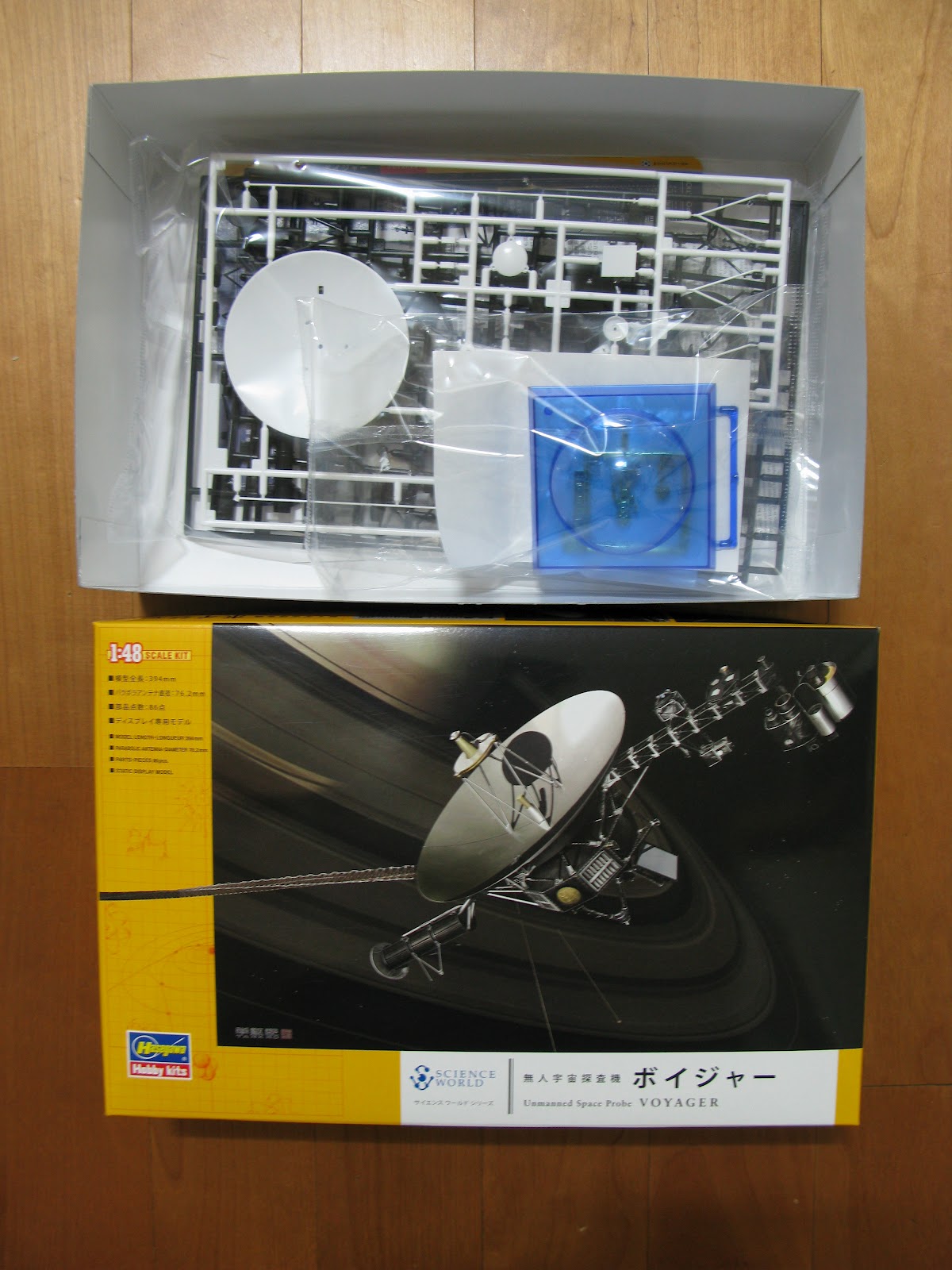
HASEGAWA HOBBY MODEL KIT 1/48 Unmanned Space Probe Voyager

The Voyager 1 and 2 unmanned space probes were launched into space in 1977 as part of the Voyager program. Voyager is a United States National Aeronautics and Space Administration(NASA) program to explore the outer planets of, and eventually the interstellar space beyond, our solar system. According to orignal NASA plans, the two probes would make near approaches to JupIter, Saturn, Uranus, and Neptune, allowing the collection of valuable data about these planets before the probes continued their respectIve voyages beyond the solar system. Both of the unmanned probes received as their own names the "Voyager" name of the overall project. Voyager 1 was launched on September 5, 1977, and Voyager 2 was launched on August 20 of that year. Actually, both probes had onginally been scheduled to be launched on the same day, but problems with the onboard systems of Voyager 1 delayed its launch, while Voyager 2 was launched on the onginally scheduled date of August 20. The 1977 launch date was significant, because the outer planets of Jupiter, Saturn, Uranus, Neptune and Pluto (which was still considered a planet at the time) were aligned in that year in such a way that the pull of their respective gravitational fields would allow the two Voyager probes to make a "Grand Tour" of near approaches to the planet using the so-called method of "swing-by" or "gravitational slingshot" space navigation.

The layout and construction of Voyager 1 and 2 were nearly identical. Each had a weight of 721.9kg, and onboard atomic batteries with a power output of 420 watts. Additionally. both were launched into space from Pad LC41 at Cape Canaveral, Florida aboard Titan lIIE Centaur rockets. Voyager I collected valuable data from its near approaches to Jupiter and Saturn and several of their moons, while Voyager 2 collected similarly valuable data from Uranus and Neptune and several of their moons, as well. The Voyager probes have so far made possible many astounding discoveries, including; Saturn-like (although not as visibly prominent) rings around Jupiter, Uranus, and Neptune; an atmosphere enveloping Triton, a moon of Neptune; volcanic activity on the surface of Io, a moon of Jupiter; and other discoveries that never would have been possible relying on Earth-based observation alone. After their respective launches, Voyager 1 and 2 proceeded on different courses into outer space. While Voyager I had been on a course that would have alIowed it to make a near approach of Pluto, its course input was changed so that it could make a near approach of Saturn moon Titan. instead.

At present (June 2012), Voyager 1 is now some 18 billion kilometers from the sun, moving away at a speed (relative to the sun's position) of 17.06km per second. Voyager 2 is now some 14.7 billion kilometers from the sun, moving away at a speed (relative to the sun's position) of 15.46km per second. Voyager 1 has long since garnered the record for "man-made object farthest from Earth" , and is scheduled to soon pass from our solar system to venture out into interstellar space.

Onboard both Voyager probes are gold-plated copper records titled "Sounds of Earth". Recorded on them are various sounds from nature, as well as greetings in 55 different languages. These recordings were attached to the Voyager probes in anticipation that they may someday be found and decoded
by intelligent extraterrestrial life.


Just pay $43 with PayPal, Worldwide Free Shipping


Visit our webstore http://www.worldhobbyist.com or http://worldhobbyist.com

2012년 5월 11일 금요일

ACADEMY PLASTIC HOBBY MODEL KIT 1/288 SPACE SHUTTLE & JUMBO 747

Althought the Space Shuttle can travel faster and farther than any other aircraft yet flying, unless it is on a space voyage, it must depend on other means of tansportation just to get from one side of the country to the other. Since it must use such large external boosters to place it into the air, it is not feasible to launch the shuttle for less than orbital flight. To provide for "local' hops. NASA obtained a giant Boeing 747 airliner from American Airlines, and altered it to carry the shuttle In a special cradle mounted to the fuselage. In addition, a pair of vertical stabilizers was Installed to Increase the stability of the 747 during the captive flights, and to provide the necessary vertical surface for safe flight in the event the shuttle collided with the 747's large tail fin.
  The 747 was specifically modified for the initial fIight testing of the spaceship. To determine the flight characteristics of the shuttle, it was mounted in the airliner and carried to altitude. During captive flights, in which the shuttle remained attached to the 747, the oontrols and other systems were tested as the pair cruised over Edwards Air Force Base. Eventually, the shuttle was carried aircraft and released as the 747 went Into a shallow dive, and the spacecraft was flown back to Edwards on its own. the final proof of its aerodynamic ability.
 The shuttle, which is about the size and weight of a medium jet airliner, Is secured to the cradle after being lifted by a hoist To reduced the drag caused by the exposed rocket engines, a streamlined shroud is attached to the rear of the shuttle. Although it cannot provide any of its own power for the flight, the lifting charocteristics of the shuttle design utilized. The pilots report that the flight characteristics of the 747, even with such a large object attached to its back, are basically the same as in normal configuration.


Visit our webstore http://www.worldhobbyist.com or http://worldhobbyist.com

Interest User